Manually prompting your AI coding assistant is already starting to feel outdated. Most tools today still work the same way: you spot a problem, write a prompt, the agent responds, you review, and the cycle repeats — putting you firmly in the execution loop rather than the strategy seat.
Google is building something designed to change that entirely.
Internally codenamed Jitro, Google’s next-generation coding agent — essentially Jules V2 — is shaping up to be one of the most significant shifts in AI-assisted software development in years. Instead of responding to individual prompts, Jitro pursues high-level goals autonomously, retains context across sessions, and tracks measurable progress across entire codebases.
This guide breaks down exactly what Google Jitro AI is, how it works, who it’s for, and why it matters for developers, agencies, and tech teams everywhere.
What is Google Jitro AI?
Google appears to be building the next generation of its Jules coding agent, internally referenced as “Jitro,” which could represent a fundamental rethinking of how developers work with AI-powered software engineering tools.
In plain terms, Jitro is an agentic coding workspace — a persistent environment where a developer defines a high-level engineering goal, and the AI autonomously figures out what needs to change in the codebase to achieve it, then executes those changes continuously until the goal is met.
Google is changing the current paradigm with a project internally called Jitro, which is essentially the second version of their AI coding agent known as Jules. Jitro, or Jules V2, is designed to be a “Persistent Collaborator” rather than just a one-shot tool. The technical shift here is moving toward “Goal-Oriented” AI.
This is a meaningful departure from every major coding assistant currently on the market. GitHub Copilot, Cursor, OpenAI’s Codex — all of them still put the developer in charge of defining each step. Jitro proposes to flip that model: define the destination, not the route.
From Jules to Jitro: the evolution
To understand Jitro, it helps to understand where it came from.
Jules V1: asynchronous task execution
Jules is an asynchronous coding agent that connects directly to your code repositories, such as GitHub. Being “asynchronous” means you can give it a task, close your laptop, and walk away. Jules works in the background, analyzing your codebase, running tests, and preparing a “pull request” for you to review later. It is already a powerful tool available in Google AI Pro and Ultra, but it still relies on you telling it what to do step-by-step.
Jules V1 was already a step forward — developers could assign discrete tasks and let the agent work independently. But it remained fundamentally reactive: it waited for instructions, executed them, and then stopped.
Jitro: goal-driven persistence
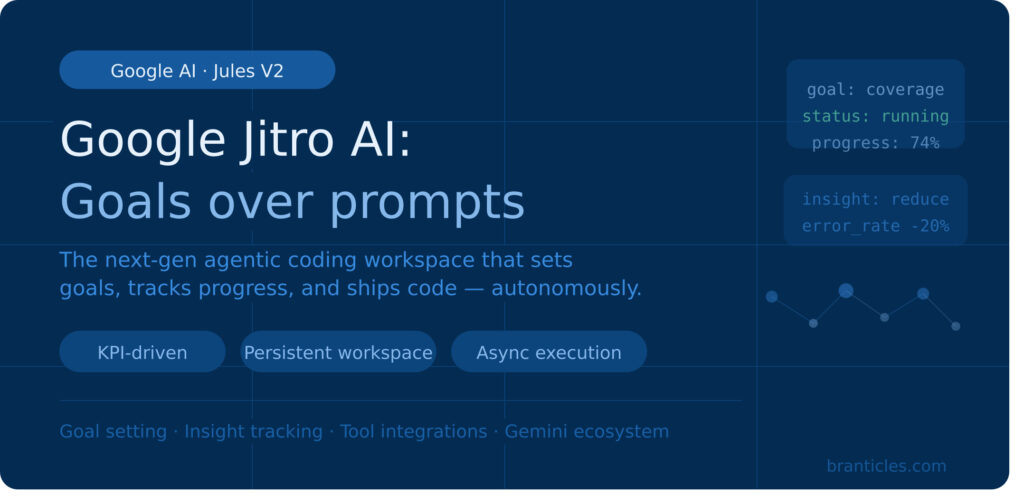
Rather than asking developers to manually instruct an agent on what to build or fix, Jules V2 appears designed around high-level goal-setting — think KPI-driven development, where the agent autonomously identifies what needs to change in a codebase to move a metric in the right direction. That’s a significant shift. Instead of telling the agent what to do, a developer would define the desired outcome — better test coverage, lower error rates, improved accessibility compliance — and the agent figures out the path to get there.
The diagram above shows this contrast clearly. The old model is a loop: prompt → execute → stop → repeat. Jitro’s model is a persistent pursuit: set goal → plan → execute → track progress → continue until done.
How Google Jitro AI works
The persistent workspace
The Google Jitro AI agent introduces a persistent workspace model designed to keep goals, reasoning, and progress connected over time instead of resetting every time work resumes. This means the agent remembers what success looks like instead of just responding to isolated prompts.
This is the foundational architectural shift. Every current coding agent — regardless of how capable it is — loses context when you close a session. You come back the next day, and you have to re-explain the project, the codebase, the goals, the constraints. With Jitro’s persistent workspace, the agent retains all of that: what you’re trying to achieve, what it has already tried, what worked, what didn’t, and what still needs to happen.
KPI-driven development
The Google Jitro AI agent introduces KPI-driven development where you specify the outcome you want improved instead of the actions required to reach it. For example, reducing error rates becomes the objective instead of debugging individual functions one at a time.
This is conceptually similar to how product managers think about goals — define a metric you want to move (test coverage from 70% to 90%; error rate reduction by 20%; accessibility score improvement to 100) and let the system determine how to get there. Engineers who’ve managed complex projects will recognize this as the difference between task management and outcome ownership.
Goal and insight tracking
Early signals point to a workspace where developers can list goals, track insights, and configure tool integrations — a layer of continuity that current coding agents don’t offer.
From what’s been discovered in the internal tooling, Jitro supports a structured workspace with specific capabilities: listing goals, retrieving individual goal details by resource name, listing insights generated by the agent, viewing the update history for specific insights, listing configured tool integrations (including MCP remote servers and API integrations), and creating new goals after the agent helps articulate them clearly.
Asynchronous execution
Like its predecessor Jules, Jitro operates asynchronously. Google Jules introduced asynchronous execution environments that allowed automation systems to operate between interaction cycles rather than waiting for prompts continuously. The Google Jitro AI agent extends this architecture into workspace-level execution awareness designed to maintain objective alignment across sessions instead of responding inside isolated request loops.
In practice, this means a developer can define a goal, close their laptop, and return later to find the agent has been working continuously — identifying what needs to change, making those changes, running tests, and preparing pull requests for review.
Key features of Google Jitro AI
Goal setting and articulation
Rather than accepting vague instructions, Jitro is designed to help developers articulate high-quality goals before execution begins. The agent creates a new goal in the workspace only after helping the user define it clearly — reducing the ambiguity that makes most AI-assisted development frustrating.
Insight generation
Jitro doesn’t just execute silently. It generates insights about the codebase, surfaces patterns it discovers during execution, and makes those insights available for developers to review. This turns the agent into a genuine contributor to engineering knowledge, not just a code writer.
Tool integration
The upcoming experience, expected to launch under a waitlist, carries messaging that positions it as a generational leap. Jitro supports configured integrations including MCP (Model Context Protocol) remote servers and external API integrations, meaning it can connect to the broader ecosystem of developer tools rather than operating in isolation.
Gemini ecosystem integration
Google has been steadily expanding its AI developer tooling through Gemini integrations in Android Studio, Firebase, and Cloud, and a goal-oriented coding agent would fit neatly into that strategy, particularly for enterprise teams that care more about outcomes than individual pull requests.
Jitro is expected to integrate with this broader Gemini infrastructure — meaning developers already working in Android Studio, Firebase, or Google Cloud could benefit from goal-driven automation without switching environments.
Who is Google Jitro AI for?
Enterprise engineering teams
If Jules V2 ships as described, the primary beneficiaries would be engineering teams managing large codebases where incremental improvements compound — performance optimization, test coverage, and accessibility compliance.
Large codebases are where continuous, goal-driven improvement compounds most dramatically. A team managing a codebase with thousands of files and years of accumulated technical debt would benefit enormously from an agent that persistently pursues measurable improvements without requiring constant human intervention.
Software development agencies
Google Jitro reduces dependency on prompt engineering because agencies define outcomes rather than writing instruction chains repeatedly across client repositories. Instruction chains often become fragile when repositories evolve across distributed contributor environments simultaneously.
For agencies managing multiple client codebases simultaneously, the shift from instruction-based to outcome-based automation is transformative. Instead of maintaining prompting workflows for each client project, teams can define quality goals per repository and let Jitro pursue them continuously.
Individual developers working on complex projects
Developers who switch between projects — or who work on long-running personal codebases — benefit from the persistent workspace model specifically because context loss is their biggest productivity drain. Jitro’s memory layer eliminates the need to re-explain project context every session.
Google Jitro AI vs competitors
vs GitHub Copilot
GitHub Copilot is primarily an inline autocomplete and chat assistant. It excels at suggesting code in context and explaining existing code, but it operates entirely at the prompt level. It has no concept of persistent goals, no memory of previous sessions, and no ability to autonomously pursue improvements over time. Jitro operates at a fundamentally different level.
vs Cursor
Cursor has introduced an “agent” mode that can execute multi-step tasks within a session, and its context handling is notably strong. But like Copilot, it resets between sessions and relies on the developer to define specific tasks rather than outcomes. Cursor has officially added a new standalone window specifically designed for running agents, allowing seamless handoffs between local and cloud processes, making it vastly easier to manage complex workflows across multiple sessions — but Jitro’s goal-persistence goes further than session handoffs.
vs OpenAI Codex agent
OpenAI’s Codex agent can execute multi-step coding tasks autonomously, but still operates primarily in response to specific developer-defined instructions. It doesn’t maintain a persistent workspace or pursue goals independently between sessions.
This would mark a departure from the task-level paradigm seen across competitors like GitHub Copilot, Cursor, and even OpenAI’s Codex agent, all of which still rely on developers defining specific work items.
The risks and challenges
No honest assessment of Jitro can ignore its significant open questions.
Trust and unpredictability
The risk, of course, is that autonomous goal-pursuing agents introduce unpredictable changes, and trust will be the key barrier to adoption.
When a developer manually prompts an agent, they review and approve each step. When an agent autonomously pursues a KPI, it may make architectural decisions that surprise the developer — restructuring code, changing interfaces, or prioritizing one metric at the expense of another. The degree of human oversight and approval required will significantly shape how Jitro is adopted in production environments.
Scope and autonomy boundaries
Autonomous goal-pursuing agents need clear boundaries. A goal like “reduce memory leaks by 20%” could theoretically be pursued through changes that affect unrelated parts of the codebase in unexpected ways. Defining the scope of autonomy — what the agent can and cannot change unilaterally — will be a critical design challenge.
Enterprise readiness
Large organizations have strict requirements around code review, security scanning, compliance, and deployment pipelines. An agent that produces pull requests autonomously needs to integrate gracefully with these processes — not bypass them. Google will need to address enterprise workflow integration carefully to achieve meaningful adoption.
When will Google Jitro AI launch?
The timing is notable. Google I/O 2026 kicks off May 19, and this is exactly the kind of showcase-ready feature Google would want to unveil alongside its broader Gemini ecosystem updates.
Google has not confirmed an official release timeline yet, but signals suggest announcements may align with major Google developer events. The product is expected to launch initially under a waitlist, with early access available to developers and teams who sign up before the broader rollout.
Given that Jules V1 is already available in Google AI Pro and Ultra subscriptions, Jitro integration into those plans seems like a natural path — though Google has not confirmed pricing or packaging.
What Jitro means for software development
The shift from prompt-based to goal-based AI development is not just a product feature — it’s a change in the mental model of what AI assistance looks like.
Right now, AI coding tools amplify execution speed. They make good developers faster. Jitro proposes to amplify outcome ownership — making it possible for a small team to pursue ambitious codebase improvements that would otherwise require a much larger workforce.
This has direct implications for how development teams are structured, how technical debt is managed, how quality metrics are tracked, and ultimately how software is priced and delivered.
Understanding the bigger picture of how AI is changing work and productivity is essential for anyone in tech. If you’re building a digital presence or a content brand alongside your development career, resources like Branticles’ guide on how to make money online and how to start a blog offer practical frameworks for building income streams around your expertise.
Implications for digital marketing and content teams
While Jitro is primarily a developer tool, its implications extend into digital marketing workflows. Many marketing teams rely on developers to maintain their websites, implement tracking, and build automation — all tasks that Jitro could help accelerate significantly.
Agencies and marketing teams exploring AI tooling should understand how tools like Jitro fit into the broader landscape of AI automation. If you’re scaling a content operation alongside technical development, how to increase organic traffic and content creation strategies from Branticles offer practical guidance on growing your digital footprint while your technical infrastructure evolves.
Marketing teams that use paid advertising will also find the goal-driven model resonant: Jitro’s KPI-driven approach to code improvement mirrors the outcome-focused thinking that good PPC management and content marketing measurement require.
For those building audience and authority alongside their technical work, how to grow your email list and insights on affiliate marketing from Branticles are worth bookmarking as complementary growth strategies.
Conclusion
Google Jitro AI represents the clearest signal yet that the next phase of AI-assisted development is not about faster prompting — it’s about eliminating prompting as the primary model entirely.
By combining persistent workspaces, KPI-driven goal execution, and asynchronous operation, Jitro proposes something qualitatively different from every major coding agent currently available. Whether it ships as described, and whether enterprise teams trust it with their production codebases, remains to be seen.
What’s certain is that the direction is clear: AI is moving from a task helper that waits for instructions to a persistent collaborator that pursues outcomes on its own terms. Jitro — if it delivers — is the most concrete version of that future yet.
Watch for announcements at Google I/O 2026 in May for the most up-to-date details on availability, pricing, and features.
Frequently Asked Questions
Q: What is Google Jitro AI? Google Jitro AI is the internal codename for Jules V2, Google’s next-generation AI coding agent. Unlike traditional prompt-based tools, Jitro operates in a persistent workspace where developers set high-level goals — such as improving test coverage or reducing error rates — and the agent autonomously identifies and executes the code changes needed to achieve them.
Q: How is Jitro different from Jules V1? Jules V1 is an asynchronous coding agent that executes specific tasks assigned by the developer. Jitro goes significantly further: it maintains a persistent workspace with memory across sessions, pursues high-level KPI-driven goals autonomously, generates insights about the codebase, and tracks progress over time — without requiring the developer to re-prompt it continuously.
Q: Is Google Jitro AI available now? As of April 2026, Jitro has not launched publicly. It is internally referenced and being prepared for a waitlist-based launch. Google I/O 2026, which begins May 19, is widely expected to be the venue for an official announcement. Jules V1, the predecessor, is currently available in Google AI Pro and Ultra subscriptions.
Q: How is Jitro different from GitHub Copilot or Cursor? Copilot and Cursor are primarily prompt-driven tools — developers define specific tasks and the agent executes them within a session. Jitro’s core differentiation is goal persistence: it maintains a workspace across sessions, autonomously identifies what changes are needed to hit a defined metric, and continues pursuing that goal without requiring the developer to restart the process each time.
Q: What types of goals can Jitro pursue? Based on available information, Jitro is designed for measurable engineering objectives such as improving test coverage percentages, reducing error or crash rates, improving accessibility scores, reducing memory leaks, and similar KPI-driven targets. The agent is intended to help developers articulate clear, high-quality goals before execution begins.
Q: Does Jitro replace developers? No. Jitro is positioned as a persistent collaborator, not a replacement. Developers remain responsible for defining goals, reviewing pull requests, approving significant architectural changes, and making strategic decisions. Jitro handles the execution complexity of pursuing those goals — identifying changes, running tests, and submitting code for review — but human judgment remains central to the process.
Q: What are the main risks of using a goal-driven coding agent like Jitro? The primary risks are trust and unpredictability. An agent autonomously pursuing a KPI may make unexpected architectural decisions or changes that affect parts of the codebase the developer didn’t intend. Defining clear scope boundaries, maintaining robust code review processes, and building developer trust in the agent’s judgment are the key challenges for Jitro’s adoption in production environments.
Q: Will Jitro integrate with existing developer tools?
A: Based on internal tooling discovered, Jitro supports integration with MCP (Model Context Protocol) remote servers and external API integrations. It is also expected to connect with Google’s broader Gemini developer ecosystem, including Android Studio, Firebase, and Google Cloud — making it accessible to developers already working within those environments.